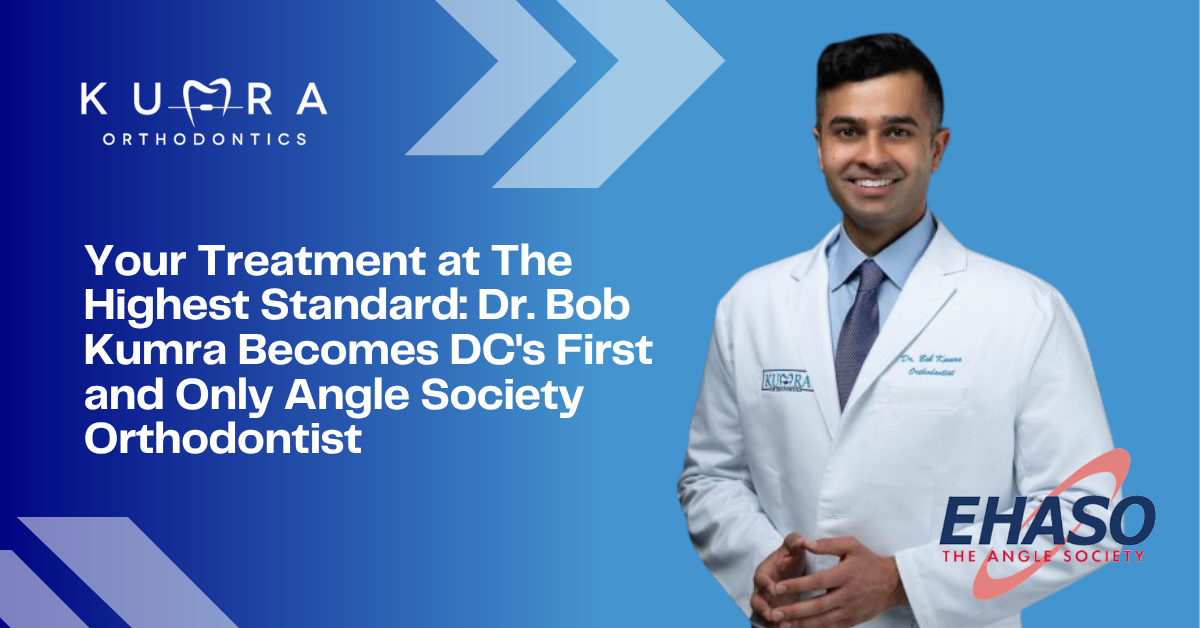
Dr. Bob Kumra of Kumra Orthodontics has become the first orthodontist in Washington DC to earn membership in the Edward H. Angle Society of Orthodontists (EHASO). This milestone marks a significant shift in the District’s clinical landscape, as this invitation-only organization represents the highest tier of peer-scrutinized credentialing in the profession. For the first time, DC residents have local access to a level of orthodontic expertise.
For you, that means access to care held to the highest clinical standard in the profession. Treatment was planned to the same scientific rigor as the most advanced orthodontic institutions in the world and built around how your teeth, jaw, and bite function together, not just how they look.
In a city where credentials are the currency of trust, professionals in law, government, and consulting understand that a title is only as strong as the scrutiny required to earn it. While most patients assume all orthodontic care is equal, the field actually operates on a strict hierarchy. Understanding this hierarchy from foundational licensing to the elite standards of the Angle Society is essential for any patient seeking functional excellence rather than just a cosmetic change.
The Foundation Every Orthodontist Must Have
To understand why Angle Society membership is a rarity, one must first understand the “floor” of the profession. Every practicing orthodontist must complete a four-year dental school program followed by an orthodontic residency accredited by the Commission on Dental Accreditation (CODA).
These residencies typically last 24 to 36 months and focus exclusively on tooth movement and facial development. Think of this stage as the “Bar Exam” of orthodontics; it is the absolute minimum requirement to obtain a license from the DC Health administration to practice. While this ensures a baseline of competency, it does not distinguish a practitioner as a leader or an innovator in complex clinical cases.
ABO Board Certification: The First Real Signal
The first true point of separation in the field is Board Certification through the American Board of Orthodontics (ABO). Unlike basic licensing, Board Certification is entirely voluntary. Currently, only about one-third of all orthodontists in the United States pursue and maintain this designation.
For the adult orthodontic care seeker, an ABO-certified doctor has gone beyond the requirements of the law. They have passed rigorous written examinations and a scenario-based clinical exam. In the professional world of Washington DC, being “Board Certified” is the expected standard for a specialist, yet it is often mistaken for the ceiling of orthodontic achievement. In reality, it is the prerequisite for the most exclusive circle in the industry.
The Angle Society: The Credential Above Board Certification
The Edward H. Angle Society of Orthodontists is named after the “Father of Modern Orthodontics.” It is not a trade association that one simply joins by paying dues. It is an international honor society where membership is by invitation only and is reserved for those who demonstrate a commitment to the highest level of clinical excellence and scientific rigor.
Dr. Bob Kumra is the first orthodontist in Washington DC to complete this process, bringing this tier of credentialing to the District for the first time. Membership in the Angle Society represents a level of peer review that is structurally impossible to fake or market around. It is a signal to the most discerning patients that their doctor’s work has been examined, critiqued, and validated by the top clinical minds in the world.
What the Membership Process Requires Dr. Kumra’s Path
To earn his membership, Dr. Kumra completed a multi-year process that far exceeds standard continuing education. The requirements he met include:
- ABO Certification: Membership is only open to those who have already achieved Board Certified status.
- 2-Year Affiliate Status: A “probationary” period involving active participation and attendance at regional and national meetings.
- 10-Case Presentation: The candidate must present ten finished patient cases that demonstrate exceptional clinical results. These cases are scrutinized by a board of examiners for alignment, occlusion (bite), and long-term stability.
- Original Thesis: Unlike standard clinical tracks, the Angle Society requires an original scientific thesis. This research must be of publication quality, contributing new knowledge to the field of orthodontics.
- Ongoing Contribution: Members must continue to present cases and research throughout their career to maintain their standing.
What Angle Society Membership Means for Your Treatment
For the patient, these credentials translate directly into clinical outcomes. The Angle Society focuses heavily on craniofacial complex evaluation. This means the treatment plan isn’t just about “straight teeth,” but about how the teeth, jaw structure, and facial aesthetics work together as a functional system.
This level of scrutiny is particularly vital for:
- Complex Adult Relapse: Correcting shifts that occur decades after childhood braces.
- Functional Excellence: Ensuring the bite is stable to prevent premature tooth wear and enamel fractures.
- Jaw Health: Using advanced diagnostics, such as 3D Cone Beam radiographs, to address the root causes of jaw pain rather than just treating symptoms.
A 5-Question Credential Checklist for DC Orthodontic Patients
When evaluating providers in the DC metro area, professionals should use a rigorous framework. If you are researching how to choose an orthodontist, use this checklist to verify their standing:
- Are they a specialist? (Did they complete a 2-3 year CODA-accredited residency?)
- Are they licensed to practice in the District of Columbia?
- Are they a member of the American Association of Orthodontists (AAO)?
- Are they ABO Board Certified? (The top 33% of the profession.)
- Are they a member of the Angle Society? (The elite tier of peer-reviewed clinicians.)
In Washington DC, Dr. Bob Kumra is currently the only practitioner who meets all five criteria.
What This Means for Washington DC Patients Right Now
For years, time-scarce DC professionals often felt they had to choose between the convenience of a downtown office and the high-level expertise found in the academic hubs of the suburbs. With this milestone, that compromise is no longer necessary.
Whether you are seeking a discreet solution like Invisalign in Washington DC or need a comprehensive evaluation for chronic jaw discomfort, the Angle Society credential serves as an objective guarantee of quality. It ensures that your treatment plan is rooted in the same scientific rigor that governs the most advanced orthodontic institutions globally.

What to Expect Next
Navigating the hierarchy of orthodontic credentials is the first step in making an informed decision for your health. The next step is a direct diagnostic assessment to see how these standards apply to your specific needs.
At your first orthodontic consultation, you should expect more than a sales pitch. You should receive a detailed breakdown of your jaw alignment, a 3D scan of your current dental structure, and a clear explanation of the functional goals of your treatment. This is where you can observe firsthand how elite credentials manifest in clinical precision.