
It’s a scenario we see often at our Washington, D.C. and Stafford offices: your child’s palatal expander was fitted last week, the initial “tightness” has settled into a routine, and then you look at the calendar. Practice starts Tuesday.
Suddenly, a wave of “expander anxiety” hits. Can they still take a hit on the lacrosse field? Will a standard mouthguard even fit over that hardware? Does the chlorine in the pool damage the metal?
If you weren’t given a specific “sports playbook” during your fitting appointment, you aren’t alone. Most parents leave the office focused on how to turn the expansion screw, only to realize the logistics of youth sports are a whole different ballgame. The good news? Your child is not benched. Here is your practical, sport-by-sport guide to keeping your athlete in the game while their smile is under construction.
Read more: Palatal expanders for kids: What DC Parents Need to Know
The Short Answer: Yes, Your Child Can Keep Playing
Let’s clear the air immediately: a palatal expander does not restrict sports participation. Whether your child is a gymnast, a fullback, or a competitive swimmer, the appliance is designed to stay put.
At Kumra Orthodontics, we believe that staying active is a vital part of a healthy treatment journey. As Dr. Bob Kumra often explains, we are working with your child’s natural growth a “golden window” that usually opens around age seven. Stopping sports would be counterproductive to the confidence we are trying to build. The only things that truly change are your mouthguard protocol and one specific rule for wrestlers.
Here is what changes by sport type, and what never changes.
The Mouthguard Problem (and How to Solve It)
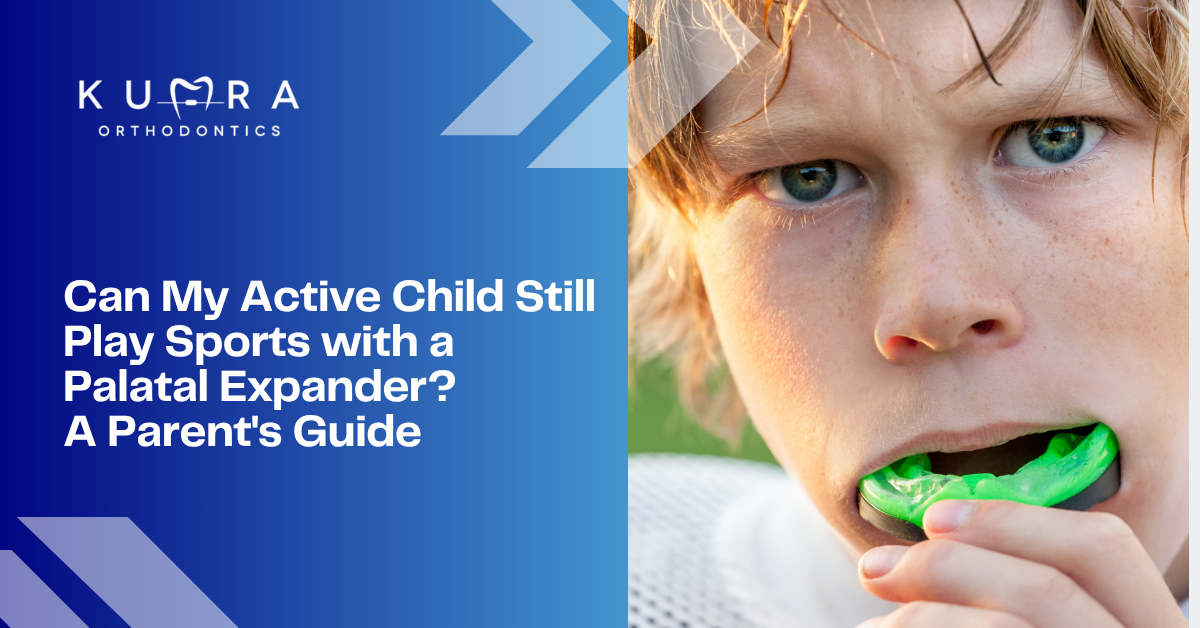
The biggest hurdle for the “expander athlete” is the mouthguard. If you’ve tried to use a standard “boil-and-bite” guard from a big-box retailer, you’ve likely found it’s a disaster.
The hardware of a Hyrax or Haas expander occupies palatal space that standard guards assume is smooth. Because the metal arms and the center-screw mechanism create “dead zones,” a standard guard won’t seat correctly. Worse, if it’s forced on, it can press against the hardware, causing sharp pain or even interfering with the expansion process.
This is a critical part of Early Orthodontics (Phase I), where we guide jaw development. A poorly fitted mouthguard can actually push against the work we’re trying to do.

Why Store-Bought Boil-and-Bite Guards Do Not Work
Standard EVA (ethylene-vinyl acetate) guards are designed to soften and mold to teeth. However, with an expander, the material can “lock” onto the metal arms if the water is too hot during the fitting process. If the guard locks onto the hardware, you risk pulling the appliance loose when your child tries to take the guard out. Additionally, standard guards leave gaps where the expander sits, reducing the actual protection during a hit.
Three Options That Actually Work with an Expander
To keep your child safe and comfortable, you have three real-world options:
- Ortho-Specific Retail Guards: Look for guards specifically labeled as “braces-compatible” or “orthodontic.” Brands like Shock Doctor (Ultra Braces model), SISU (NextGen), and Under Armour offer models with a wider palatal channel and medical-grade silicone that won’t “lock” onto metal.
- Orthodontist-Grade Custom Guards: This is the gold standard. During a monitoring visit, we can create a pressure-laminated custom guard. This provides the highest level of protection because it is trimmed precisely to the expander’s profile. We often recommend this for high-impact sports like football or lacrosse for our Phase I patients.
- The “Parent-Trimmed” Method: If you have a temporary upper tray guard, you can manually adapt it. Use curved heavy-duty shears to create a palatal cutout that mimics the expander shape. After trimming, dip the edges in warm water or use a lighter to dull any sharp plastic edges so they don’t irritate your child’s gums.
Contact Sports: Football, Basketball, Lacrosse, and Wrestling
If your child is heading into a high-impact environment, their Teen Orthodontics investment needs protection. A hit to the face is stressful enough without worrying about bent hardware.
- Football & Lacrosse: These sports require a mouthguard, and fortunately, the helmet provides an extra layer of structural safety. Ensure the mouthguard is “tethered” to the face mask if required by local league rules (common in NFHS mandates).
- Basketball: Statistics show that “elbow-to-palate” impacts are surprisingly high in youth basketball. Because there is no helmet, a high-quality ortho-guard is a must. The expander isn’t more vulnerable than natural teeth, but a split lip caught on a metal arm is a complication we’d all like to avoid.
- Wrestling (The “Wrestling Exception”): This is the only sport that warrants a pre-season check-in. Under NFHS Rule 4-2-9, athletes with fixed orthodontic appliances (like an expander) must wear a mouthguard that covers both the upper and lower arches. Because wrestling involves sustained jaw pressure and face-down positions, we need to ensure the dual-arch guard doesn’t put undue stress on the expander’s anchor molars.
Swimming: No Restrictions, No Mouthguard Needed
We often hear from parents worried about the “aquatic impact” on an expander. Does chlorine oxidize the metal? Does salt water cause bacterial buildup in the screw mechanism?
The answer is a definitive no. The high-grade alloys and acrylics used in modern expanders are entirely water-resistant. No mouthguard is needed for lap swimming or team swimming. If your child plays water polo, the same “contact sport” rules apply only if they are in a position where head contact is likely; otherwise, they are free to swim unencumbered. Just ensure they give the appliance a quick rinse with fresh water after their session to prevent any lingering pool-water taste.
Running, Gymnastics, Baseball, Tennis, and Other Activities
For non-contact sports, the expander is essentially “invisible” to the activity.
- Running & Cycling: No restrictions.
- Gymnastics & Cheer: Some parents worry that the “vibration” of a hard tumbling landing might be uncomfortable. While a recently “turned” expander might cause slight soreness during a high-impact landing, it is not a safety risk.
- Baseball & Softball: While these are technically non-contact, the risk of a stray ball means the AAO still recommends a mouthguard. However, a standard “ortho-compatible” retail guard is usually more than enough.
The One Scenario That Warrants a Same-Day Call
While expanders are sturdy, “sports happen.” You don’t need to call us for general soreness (which is normal after an adjustment), but there is one scenario that requires immediate attention.
If your child takes a direct hit to the face and you notice any of the following, contact Kumra Orthodontics immediately:
- A “Popped” Band: The metal ring around the back molar feels loose or has come off the tooth.
- Appliance Displacement: The expander feels like it has shifted to one side or is pressing painfully into the roof of the mouth (palatal hematoma).
- A Bent Screw: The adjustment mechanism looks visibly distorted.
A loose or shifted expander can cause unwanted tooth movement or a “relapse” in the space we’ve gained. A quick same-day assessment allows us to reset the appliance and keep your treatment timeline on track.
Game On: Bring These Notes to Your Next Appointment

Your child’s orthodontic journey shouldn’t mean a season on the sidelines. To make sure your athlete is fully prepared, we recommend taking a quick photo of your current mouthguard’s fit and bringing it to your next monitoring visit.
Our team can check the “bite alignment” and ensure the guard isn’t interfering with the expander’s movement. Whether you are navigating Early Orthodontics or preparing for the teen years, we are here to ensure that “Game Day” is a success.

