As an orthodontist and a parent myself, one of the most common questions I get from families in Washington, D.C. and Stafford is, “What is the appropriate age for braces?” It’s a question rooted in a desire to do what’s best for your child’s health and confidence, or perhaps, to finally invest in your own. The uncertainty about timing, wondering if you’ve missed a critical window or if it’s “too late”, is completely normal.
The truth is, there isn’t a single “perfect” age, but there are ideal windows of opportunity for evaluation and treatment. This guide is designed to give you clear, reassuring answers for every age group, from young children to teens and adults. We’ll walk you through the key milestones so you can feel confident and prepared for your family’s smile journey.
The Short Answer: Key Ages and Stages for Orthodontic Care
For those who want the quick answer, orthodontic care follows a well-established timeline recommended by the American Association of Orthodontists (AAO).
- Age 7: First Orthodontic Check-Up. This is not about getting braces. It’s a crucial preventative screening to assess jaw growth and the eruption of permanent teeth, allowing us to identify and intercept potential issues early.
- Ages 10-14: Most Common Time for Full Braces. This is the “standard” window for comprehensive treatment. With most permanent teeth in place and the jaw still growing, we can efficiently guide teeth into their ideal positions.
- Ages 18+: It’s Never Too Late for a Perfect Smile. Adult orthodontics is more popular than ever, with roughly 1 in 4 patients being adults. Modern treatments are designed to be discreet and effective, fitting into the lifestyle of a busy professional.
The Smile Timeline: A Visual Guide to Your Child’s Orthodontic Journey

The First Check-Up: Why Age 7 is the Magic Number
The AAO’s recommendation for a check-up by age 7 often surprises parents. The goal isn’t to put braces on a second-grader. Instead, this early evaluation is the most important step in preventative care. By this age, the first adult molars have typically erupted, establishing the back bite. This allows an orthodontist to spot subtle issues with jaw growth or emerging teeth that may become significant problems later.
Think of it as a wellness check for your child’s future smile. Early detection can simplify or even eliminate the need for more complex treatment down the road.
What We Look For in a 7-Year-Old: The 5-Point Smile Check for Parents
When you look at your child’s smile, you can watch for the same key indicators we assess during a clinical exam. Here is a simple checklist of things to look for:
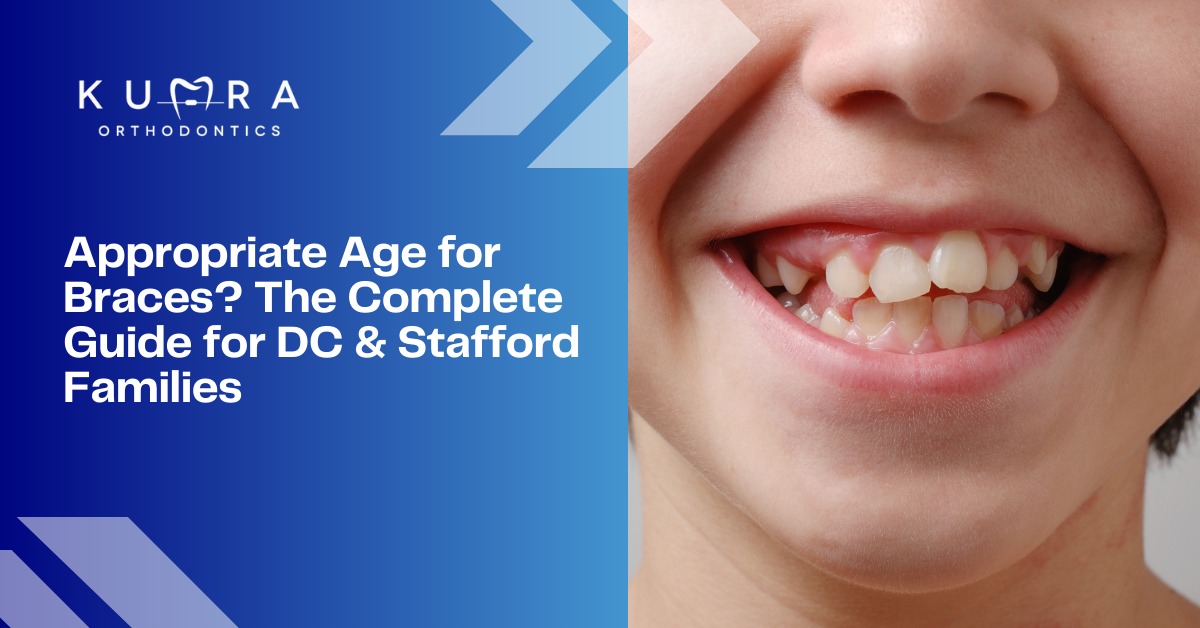
- Severe Crowding or Spacing: Noticeable overlapping of teeth or large gaps where permanent teeth have come in. This happens when the jaw is too small or teeth are too large to fit correctly.
- Crossbites (Front and Back): When you look at your child’s bite, the upper teeth should sit slightly outside the lower teeth, like a lid on a box. If any bottom teeth sit outside the top teeth, it’s a crossbite. This can cause lopsided jaw growth if left unaddressed.
- Overbites (Overjet) & Underbites: An overjet is when the top front teeth protrude far forward (“buck teeth”), making them prone to injury. A deep overbite is when the top teeth cover too much of the bottom teeth.
- Harmful Oral Habits: Persistent thumb or finger sucking past age 5 can physically reshape the jawbone and flare the front teeth out, often creating an “open bite” where the front teeth don’t touch.
- Jaw Growth & Symmetry: Look at your child’s chin. Does it seem shifted to one side? Do the midlines of the top and bottom teeth line up? Asymmetry can indicate a growth imbalance that is best guided at a young age.
The “Braces Years”: Why Ages 10-14 Are the Ideal Time for Treatment
This age range is considered the “golden window” for comprehensive orthodontics because it presents a perfect storm of biological advantages. Most, if not all, permanent teeth have erupted, and adolescents are typically in their pubertal growth spurt.
The Science of the Teen Smile: Growth & Timing
An orthodontist can leverage a teen’s natural growth to correct bite issues and align the jaws much more effectively. Think of it like molding clay when it’s still soft. During these years, the jawbone is more pliable and responsive to the gentle forces of braces or aligners. We can guide the teeth and jaw into their ideal positions with less effort and in less time than would be required once growth is complete. This is the most efficient and effective time for a full smile transformation.
A Parent’s Guide: Types of Braces for Teens
Choosing a treatment option with your teen is a partnership. It’s about balancing clinical needs with their lifestyle and personal preferences. As Invisalign Provider—the top 1% in the nation—we have deep expertise in all modern options.
Is It Too Late for Me? A Guide to Adult Orthodontics
If you’re reading this for yourself, the answer is an emphatic “no.” It is never too late to invest in your health and confidence. The “Zoom Effect” has made many professionals in the DC metro area more aware of their smiles, and seeking treatment is a powerful step in personal and career development.