As a parent, you have a sixth sense for your teenager’s well-being. You notice the subtle shifts: a new reluctance to join family photos, a quieter presence in social settings, or a hesitation to laugh freely. You might see them becoming more withdrawn and chalk it up to normal adolescent awkwardness. But what if these changes are connected to something you might overlook, their confidence in their smile?
For over 15 years, I’ve worked with teens across the Washington, D.C. and Stafford, VA, areas. I’ve seen firsthand how a teen’s perception of their smile can profoundly impact their emotional state and social behavior. This guide isn’t about generic parenting advice; it’s a clinical look at the powerful, data-backed connection between dental alignment and your teen’s self-esteem, academic life, and future success.

Beyond “Teen Awkwardness”: The Science of How a Smile Shapes the Brain
We often think of a smile as the result of happiness. But what if it is also a cause? This is the core idea behind the Facial Feedback Hypothesis, a concept foundational to psychology.
The theory posits the physical act of smiling sends signals to the brain, creating and amplifying positive emotions. A landmark 1988 study by Strack, Martin, and Stepper demonstrated this by having participants hold a pen in their teeth (forcing a smile) or their lips (forcing a pout) while reading cartoons. The “smiling” group rated the cartoons as significantly funnier, proving facial muscle activity directly influences emotional experience.
This is not just theory. It is biochemistry. When your teen genuinely smiles, their brain releases a cascade of neurotransmitters:
- Endorphins: These act as the body’s natural pain and stress relievers.
- Dopamine: This activates the brain’s reward centers, creating feelings of pleasure and reinforcing the behavior.
- Serotonin: A natural antidepressant, this neurotransmitter lifts mood and promotes a sense of well-being.
When a teen is self-conscious about their teeth, they suppress this natural, mood-boosting mechanism. They learn to hide their smile, inadvertently preventing their brain from receiving these crucial positive signals. This creates a cycle where a lack of smile confidence contributes to a lower emotional state.
Why is My Teen Struggling? Understanding the Roots of Low Self-Esteem
The teenage years combine academic pressure, hormonal changes, and the search for identity. Modern pressures magnify these challenges.
- Constant Digital Scrutiny: The American Psychological Association (APA) reports adolescents who spend more than three hours per day on social media face double the risk of poor mental health outcomes. They are constantly exposed to the curated highlights of their peers, leading to relentless social comparison. In one survey, 46% of teens reported social media made them feel worse about their body image.
- Peer Groups and Belonging: The need to fit in strongly drives teen behavior. Fear of judgment or bullying causes teens to retreat. They silence their own voices and personalities to avoid unwanted attention.
- Academic and Future-Related Stress: The pressure to succeed in school and plan for the future feels overwhelming. Setbacks in this area are often internalized as personal failures.
The Data on Dental Alignment: A Review of the Research on Teen Psychosocial Health
The link between a teen’s smile and their mental well-being is not just anecdotal. It is extensively documented in clinical research. The orthodontic term for misaligned teeth is malocclusion. Studies consistently show specific common teen orthodontic issues have a significant psychosocial impact on adolescents.
Peer-reviewed research published in journals like The Angle Orthodontist and the American Journal of Orthodontics and Dentofacial Orthopedics has established a clear correlation. One study by Gavric et al. (2015) found that adolescents with greater malocclusion severity reported significantly higher levels of social inhibition and lower self-esteem compared to their peers.
This evidence reframes orthodontics from a purely cosmetic choice into a vital tool for a teen’s holistic development. Addressing dental alignment is not just about aesthetics. It is about addressing a documented barrier to psychosocial health.
Impact on Social Behavior: The Retreat from Connection
The data translates into real-world scenarios you see every day. Insecurity about teeth often leads teens to “retreat” from social connection to avoid judgment.
I once had a patient, a gifted 15-year-old debater from Arlington, who suddenly started refusing to participate in tournaments. His parents were baffled. During his consultation, he quietly admitted he had become intensely self-conscious of his smile when speaking in front of a crowd. Orthodontic treatment straightened his teeth and restored his passion for debate.
Impact on Academic Engagement & Future Ambitions
The ripple effects of low smile confidence extend far beyond the social sphere and into the classroom. This lack of confidence directly impacts academic success and shapes a teen’s future aspirations.
- Classroom Participation: A teen worried about their teeth is less likely to raise their hand, volunteer for a presentation, or actively participate in group discussions.
- Leadership Roles: Running for student council or captaining a team requires a level of visibility overwhelming for a self-conscious teen. They often opt out of these character-building opportunities.
- Future Ambitions: Low self-esteem in adolescence leads teens to unconsciously “foreclose” on careers requiring public speaking or face-to-face interaction, such as law, communications, or executive leadership. They often steer themselves toward a “background” role to avoid future scrutiny.
A Parent’s Observational Checklist: Is Smile Insecurity Affecting Your Teen?
This checklist, developed from years of clinical observation, helps you identify subtle behaviors indicating your teen is struggling with smile insecurity.
- Hand-to-Mouth Shielding: Do they instinctively cover their mouth with a hand or sleeve when laughing or talking?
- Closed-Mouth Smiling: Do they consistently smile for photos with their lips pressed together?
- Dampened Laughter: Do they suppress a full laugh or cut a smile short to minimize how long their teeth are visible?
- Gaze Aversion: Do they look down or away when speaking, redirecting focus from their face?
- Muffled Speech: Do they seem to speak with a restricted mouth opening, as if trying to hide their teeth?
- Activity Avoidance: Have they stopped participating in activities they once loved, like drama, debate, or even certain social events?
Checking several of these boxes is a strong signal your teen’s withdrawal is directly linked to how they feel about their smile.
Your Path Forward: How to Support Your Teen’s Journey to Confidence

How to Gently Raise the Topic of Their Smile
Emotional support is essential. Sometimes a physical barrier exists. Removing it allows a teen’s natural confidence to flourish. This is where modern orthodontics becomes a transformative partner.
If you suspect their smile is a source of insecurity, starting the conversation requires a gentle approach. Avoid phrases like, “You need to fix your teeth.” Instead, try a non-confrontational, empathetic approach:
- “I want you to feel amazing about every part of yourself. I’ve noticed you seem hesitant to smile lately. Is anything on your mind?”
- “You have a great laugh, and it seems like you are holding it back sometimes. I’m here if you ever want to talk about it.”
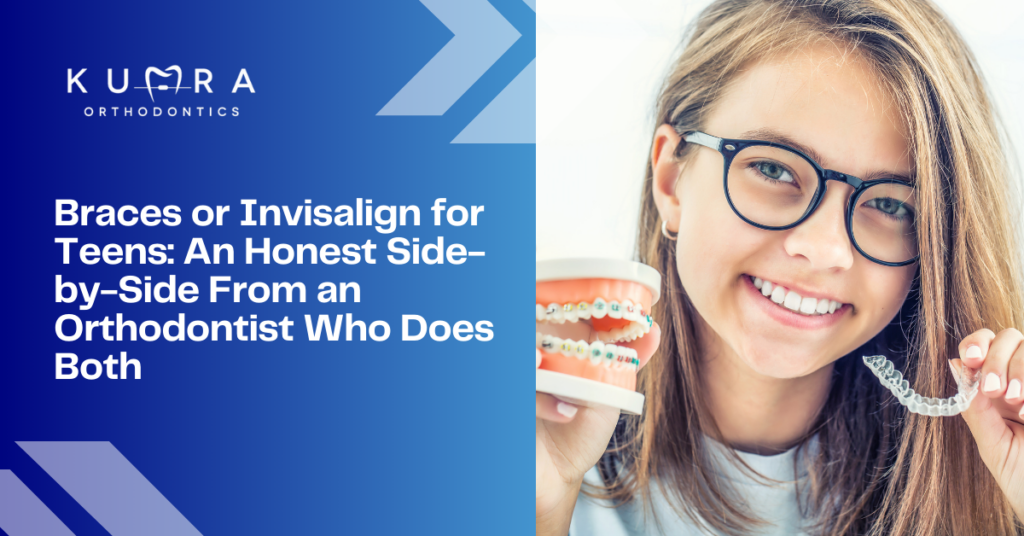
The goal of treatment is not simply “fixing teeth”. It is about removing a barrier to self-expression. Today’s advanced orthodontic treatments are designed with the teen experience in mind. For many teens, the discretion of a solution like Invisalign® Teen is the key to their willingness to start treatment. Seeing that many celebrities have had braces also helps normalize the experience. For others, today’s low-profile, modern braces are more efficient and comfortable than ever before. Understanding the treatment process from start to finish also provides clarity.
Read more: Invisalign or Braces for Teens
Is a New Smile the Next Step?
If you identified that your teen’s smile is holding them back, addressing it is one of the most direct and impactful ways to restore their confidence. Orthodontic treatment is not about aesthetics alone. It is about removing a barrier to self-expression.
With modern options like discreet clear aligners and low-profile ceramic braces, treatment is easier and more comfortable. We create treatment plans that fit a teen’s lifestyle. They still play sports, participate in music, and enjoy their favorite foods with minimal disruption. You can see what to expect from the process in our teen braces timeline for 2026.

It is About More Than Just Straight Teeth
Choosing to begin orthodontic treatment is an investment in your teen’s long-term confidence, social well-being, and happiness. It gives them the freedom to laugh without thinking, to speak up with assurance, and to move through the world without a nagging insecurity holding them back.
If you think your teen’s confidence would be transformed by their smile, we invite you to a complimentary, no-pressure consultation. Visit our Washington, DC, or Stafford, VA, office. We will use our comfortable iTero 3D scanner to show a simulation of their future smile and explore options together. Parents often have questions about cost, which our financial guide for every age helps answer.