6 Differences Between Invisalign and Metal Braces
1. Price
It is essential to discuss the cost of treatment with your orthodontist before making a decision. If you have dental insurance, your provider may be able to reimburse you for a portion of the entire cost of braces or Invisalign. Contact your insurance company or verify your coverage to get an idea of how much braces or Invisalign will cost you in the long run.
2. Appearance
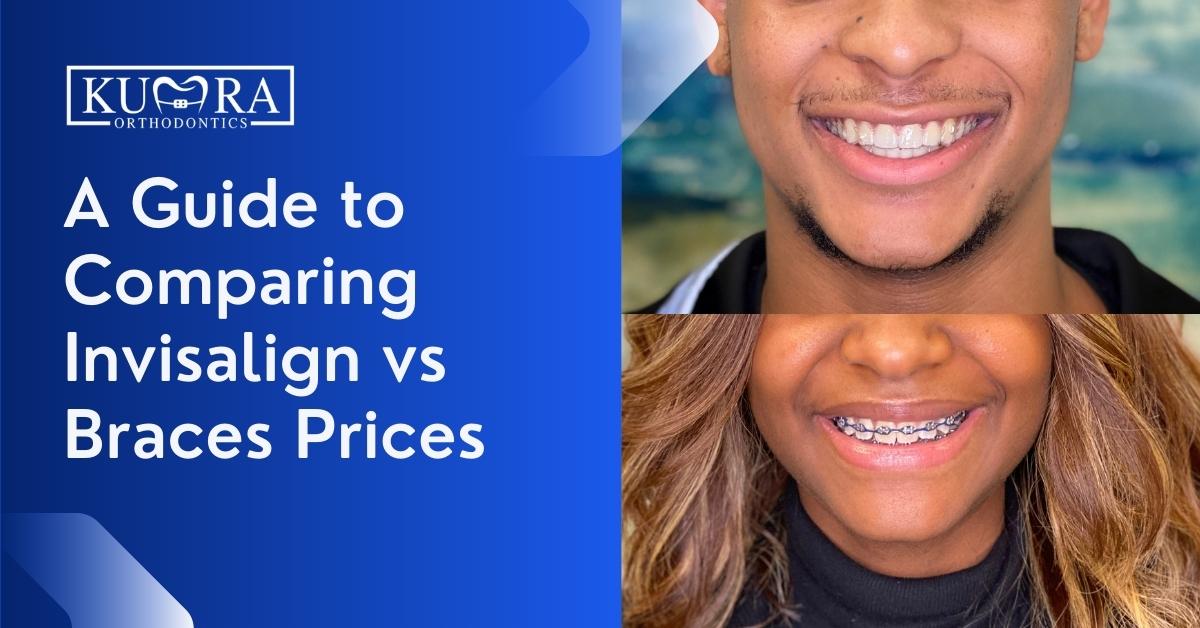
When contrasting braces with Invisalign, the most glaring difference is their appearance, where Invisalign always wins. Metal braces are apparent compared with Invisalign, which is nearly undetectable with the naked eye.
Clear plastic Invisalign trays are used to align teeth, while metal braces are used to straighten them. Choosing different colored bands for metal braces is something that some youngsters love doing, but for the most part, both children and adults prefer the aesthetic of Invisalign.
If you want the alignment of your teeth to be as unobtrusive as possible, Invisalign is the best option for you.
3. Comfort
Straightening your teeth is not typically a pleasant experience. Invisalign and braces both have the potential to cause discomfort while realigning your teeth.
Invisalign works to place less pressure on the teeth, thus making it more comfortable than traditional braces. Braces can also have sharp edges that can injure the inner lip and the tongue if worn incorrectly.
If you or your child participates in sports, metal braces may pose a safety hazard if they come into contact with another player.
Over time, people become accustomed to wearing braces or Invisalign and discover that they can be reasonably comfortable.
4. Effectiveness
The use of braces has long been practiced to straighten teeth and make smiles more attractive. Orthodontic braces are unable to be removed by the patient; as a result, the patient is required to wear them 24 hours a day, seven days a week, as prescribed by the orthodontic specialist.
It is challenging to adhere to the recommended time when using Invisalign because the trays are removable. You will also lose the effect of the trays if you misplace or forget to wear them, so be careful not to lose them.
The average number of hours spent wearing the Invisalign trays is fewer than the suggested amount, which can increase the amount of time it takes to finish treatment.
Additionally, in circumstances where the teeth are badly misaligned, traditional braces are more effective than clear aligners. Invisalign is unable to straighten teeth that are rotated or overlapped in all situations.
If you are unsure whether you could be a good candidate for Invisalign, you can schedule an appointment to find out.
5. Convenience
Invisalign and braces both have their advantages and disadvantages regarding convenience.
Braces have the advantage of not needing to be removed, but they can inconveniently cause trouble chewing certain foods.
Invisalign is a great option when you want to eat hard or sticky foods. The only problem is that sometimes patients forget to take the trays out and store them properly.
If you or your child is prone to misplacing things, Invisalign may not be the ideal choice for you or your child. In addition, it can be challenging to excuse oneself from social situations to remove the Invisalign trays before eating and put them back in again after eating.
6. Care and Cleaning
Your teeth should always be clean, regardless of whether you are wearing braces or Invisalign aligners. It is usually easier to keep your teeth clean when you have braces because you brush and floss as usual. There may be times, however, when you need to clean the metal with a smaller brush.
Brushing and flossing are the same as traditional braces, but some extra effort is required to keep the aligner trays clean. Every time you eat, you should wipe down the serving platters. You can clean your Invisalign aligners with warm water and a toothbrush, or you can use a particular cleaning solution designed just for Invisalign.
It can take a lot of time to clean every crevice in the Invisalign tray, even when you are at home. Furthermore, a buildup of bacteria or solid food might occur if the area is not cleaned correctly.
When you wear braces or Invisalign, it is even more vital to be vigilant about your dental health, so make sure to brush and floss regularly.

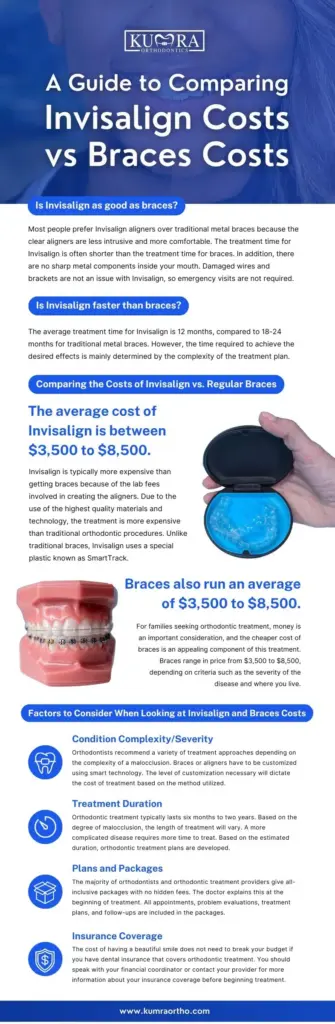
Factors to Consider When Looking at Invisalign and Braces Prices
1. Condition Complexity/Severity
Orthodontists recommend a variety of treatment approaches depending on the complexity of a malocclusion. For instance, you can use metal braces, ceramic braces, aligners, or lingual braces to straighten your teeth. Each appliance is made using different materials and requires different technology. Braces or aligners have to be customized using smart technology. The level of customization necessary will dictate the price of treatment based on the method utilized.
2. Treatment Duration
Orthodontic treatment typically lasts six months to two years. Based on the degree of malocclusion, the length of treatment will vary. A more complicated disease requires more time to treat. Based on the estimated duration, orthodontic treatment plans are developed. When using transparent aligners, a more extended treatment period (depending on how complex the issue is) may require the use of additional aligners, increasing the price of customization and manufacture. Therefore, overall treatment costs will increase.
3. Plans and packages
The majority of orthodontists and orthodontic treatment providers give all-inclusive packages with no hidden fees. The doctor explains this at the beginning of treatment. All appointments, problem evaluations, treatment plans, and follow-ups are included in the packages. Additionally, some suppliers allow for payment in installments instead of a single large payment. Pick a treatment plan that accommodates your budget and makes you happy on the inside.
4. Insurance coverage
The fact that your dental treatment is covered by insurance makes a significant difference in the overall price. The price of having a beautiful smile does not need to break your budget if you have dental insurance that covers orthodontic treatment. You should speak with your financial coordinator or contact your provider for more information about your insurance coverage before beginning treatment.

Benefits of Invisalign Compared to Getting Braces
1. Removable
One of the most significant advantages of using Invisalign as a treatment option is that the trays can be removed, letting you eat and drink without worrying about food being caught between your teeth.
2. Appearance
There is a common desire to improve one’s teeth but not to appear like one just graduated from high school. Although clear brackets are a better alternative to metal and wire bracing, the wiring remains visible. Patients can now choose between lingual and ceramic braces to make their braces less visible. So, if the sight of metal braces bothers you, you can still profit from their strength.
On the other hand, most people don’t even realize when someone is wearing Invisalign clear aligners. Clear aligners from Invisalign are a virtually unnoticeable technique to straighten your teeth and smile.
3. Comfort
Traditional braces’ wire and brackets might rub against and irritate the inside of your mouth. They can also be uncomfortable during sports, especially if you are smacked in the mouth.
Invisalign therapy is comfortable to wear and, unlike braces that are permanently connected to your teeth, can be removed as needed. This means you can do everything you normally would, such as cleaning and flossing your teeth, eating all of your favorite meals, and participating in sports without pain.
The Invisalign treatment technology also ensures that your teeth shift gradually, gently, and effectively, which means you will have less pain as your teeth move into their intended position.
Treatment time
It is recommended that Invisalign be worn around 22 to 24 hours each day for 6 to 18 months. Metal braces may be a preferable alternative for those who have more complex dental disorders, although this will also depend on the patient’s requirements.
Cleaning
You can clean Invisalign trays with an Invisalign cleaning system, or by brushing and rinsing the trays in lukewarm water. This should be done after you eat or drink anything besides water, and in the morning and night.
Now, it may be challenging to remove your aligners. At Kumra Orthodontics, we ensure to guide our patients on how to manage their Invisalign aligners.
Other Factors to Consider When Deciding Between Invisalign and Regular Braces
Metal vs. Plastic
The most noticeable difference between Invisalign and braces is the way they look on the outside. You should be familiar with the operation of each of these orthodontic instruments to grasp the distinction better. Braces are applied to the teeth by an experienced orthodontist who uses bonding material to affix brackets to each tooth.
A thin, metal wire known as an archwire is then attached to complete the structure from bracket to bracket. The wire provides a little tension on the teeth, which causes them to move. Unlike traditional braces, Invisalign utilizes a series of computer-generated, clear removable aligners that are worn over time to move teeth into their correct position gradually.
Invisalign aligners are smoother and more pleasant than their metal counterparts, and they are nearly invisible, making it likely that others will not even notice you are wearing them. They are also removable, making it unlikely that you will experience any discomfort while wearing them.
Metal braces, on the other hand, are not the only alternative, as previously stated. In addition to metal braces, many clinics also offer ceramic braces, which are less visible because of their ceramic material. Braces made of ceramic or transparent material are not as durable as metal braces.
Moderate vs. Challenging
A significant factor to consider when selecting which orthodontic treatment is right for you is the amount of straightening your teeth currently require.
Orthodontic treatment using traditional braces is more effective when you have challenging orthodontic demands, such as when you need to straighten severely misaligned teeth or when you have teeth that are sitting at dramatically different heights. Various dental movements can be more challenging with plastic shells, which is why this is the case. Invisalign can be a good solution for people with mild to moderate crowding and alignment problems or who have previously had orthodontic treatment but did not wear their retainers and experienced some relapses.
More Visits vs. Fewer Visits
With traditional braces, you would visit your orthodontist every month for fresh wires and tightening, which would take place in Stafford, Virginia, and Washington, DC. With Invisalign, you will only need to update your aligner trays every two weeks and will only need to visit the dentist every four to six weeks, on average.
Food Restrictions vs. Eat What You Want
In order to prevent dental problems, you should be selective about what you consume. Kumra Orthodontics recommends avoiding sticky, hard, or extremely sweet foods, which can damage brackets and wires or cause cavities.
Patients who use Invisalign take their aligners out whenever they eat or drink, so they do not have the same food limitations that people who wear braces do.
Related: Can You Drink Soda with Invisalign?
Brushing vs. Soaking
The clear aligners from Invisalign allow you to wash and floss your teeth as usual, which is essential for maintaining your periodontal health. Every time you take out your aligners, you should brush your teeth and rinse them well. Make sure you soak them once a day to keep them in good condition.
The permanent nature of traditional braces in the mouth makes them more prone to food trapping and more challenging to clean. Brushing and flossing the teeth at least twice a day is essential for removing food particles.
Kumra Orthodontics offers a variety of orthodontic treatments, and its professionals are capable of delivering you a beautiful smile based on the treatment method that is most appropriate for you. You can request an appointment online or call one of our convenient locations in Stafford, Virginia, or the Washington, DC region to schedule your initial consultation.

Have difficulty deciding between Invisalign and braces prices?

The benefits of orthodontic treatment outweigh the costs by a wide margin. It is an investment in your oral health’s general well-being. If you are still unsure whether you should go ahead with it due to the costs involved, you may contact a reliable orthodontic clinic that offers Invisalign around your area for more information.