

A Parent’s Guide to Making an Informed Decision
You want the best for your child’s health and confidence. A dentist may have mentioned an “orthodontic evaluation,” or you notice crowded teeth or a bite that seems off. Now you are hearing about “Phase 1” or “orthodontic early treatment,” and it comes with many questions and concerns.
As a parent in the competitive Washington, DC, or busy Stafford, VA, area, you want to make the right choice for your child’s well-being and your family’s budget. Is this treatment necessary, or is it an extra, avoidable cost?
At Kumra Orthodontics, we believe our role is to be your partner in that decision. “Our goal is to provide total clarity for you to make the best decision for your family’s health and budget,” says Dr. Bob Kumra. “We’re committed to demystifying the costs and process, helping families understand every aspect of their investment in a healthy smile.” This guide gives you a clear framework, helping you weigh the costs and benefits with confidence.
First, What Is Phase 1 Orthodontic Treatment?
Phase 1 Orthodontics, also known as interceptive treatment, is a proactive approach for children, typically between ages seven and ten. This treatment prepares your child’s jaw for healthy, straight permanent teeth. It is not about creating a perfectly straight smile yet. It is about correcting underlying structural issues while the jaw is still growing and malleable.
The American Association of Orthodontists recommends a child’s first visit to an orthodontist by age 7. As Dr. Kumra explains, “This does not mean your child needs braces at age seven. It is simply the ideal time for an initial assessment to see how their adult teeth and jaws are developing.”
The primary goals of this early phase are specific:
- Guide Jaw Growth: Correcting imbalances between the upper and lower jaws to promote a more symmetrical facial structure.
- Create Space: Widening the dental arch to ensure there is enough room for all permanent teeth to erupt properly, reducing the risk of severe crowding or impactions.
- Correct Harmful Habits: Intervening to stop habits like thumb-sucking or tongue-thrusting that deform bone growth.
- Prevent Dental Trauma: Realigning protruding front teeth that are at high risk of being chipped or fractured.
The Big Question: Is Early Treatment Necessary or an Extra Cost?
This is a critical question. Not every child needs Phase 1 treatment. A responsible orthodontic practice prioritizes the patient’s long-term health, not immediate treatment. Our philosophy at Kumra Orthodontics is “Growth Guidance,” not “Treatment First.” For many children, the best approach is to monitor their development at no charge and wait for the ideal time for a single phase of comprehensive braces as a teenager.
Certain conditions require immediate intervention to prevent more severe and costly problems later on. We use a clear framework to distinguish between issues that are urgent versus those that can be safely monitored.
| Urgent: Requires Phase 1 Intervention | Can Be Monitored: Wait for Comprehensive Treatment |
| Crossbites: When upper teeth bite inside the lower teeth, it can cause the jaw to shift and grow asymmetrically. | Mild to Moderate Crowding: If there is adequate space for permanent teeth to erupt without issue. |
| Severe Underbites: When the lower jaw grows faster than the upper jaw, early guidance can prevent the need for future jaw surgery. | Minor Gaps (Diastemas): Spaces between the front teeth often close naturally as other permanent teeth erupt. |
| Severe Protrusion (Overjet): Upper front teeth that stick out, posing a high risk for fracture from falls or sports. | Deep Bites: Excessive overlap of the front teeth is often more efficiently treated during the adolescent growth spurt. |
| Harmful Oral Habits: Persistent thumb-sucking or tongue-thrusting that is actively warping the jaw structure. | Mild Rotations: Slightly crooked teeth that do not impact oral health or the eruption of other teeth. |
| Ectopic Eruption/Impaction: A permanent tooth is erupting in the wrong spot and may damage the roots of an adjacent tooth. |
A Practical Cost-Benefit Analysis for Parents in DC & Virginia
Think about Phase 1 treatment as a long-term investment. You must weigh the initial cost against the future financial, medical, and emotional costs of waiting. Reviewing a guide to braces costs will help you understand the full financial picture.
The “Benefit” Side: The Long-Term ROI of Acting Now
Proactive orthodontic care often provides a return on investment of 3x to 10x because it helps your child avoid secondary procedures.
- Financial ROI: Early intervention prevents the need for costlier treatments. For example, correcting a severe underbite with an appliance in a growing child avoids corrective jaw surgery, a procedure that costs $20,000 to $50,000. Creating adequate space early prevents the need for surgical extractions ($225–$600 per tooth) or treatment for impacted teeth. This often results in a shorter, less complex, and more affordable Phase 2 (full braces) treatment later.
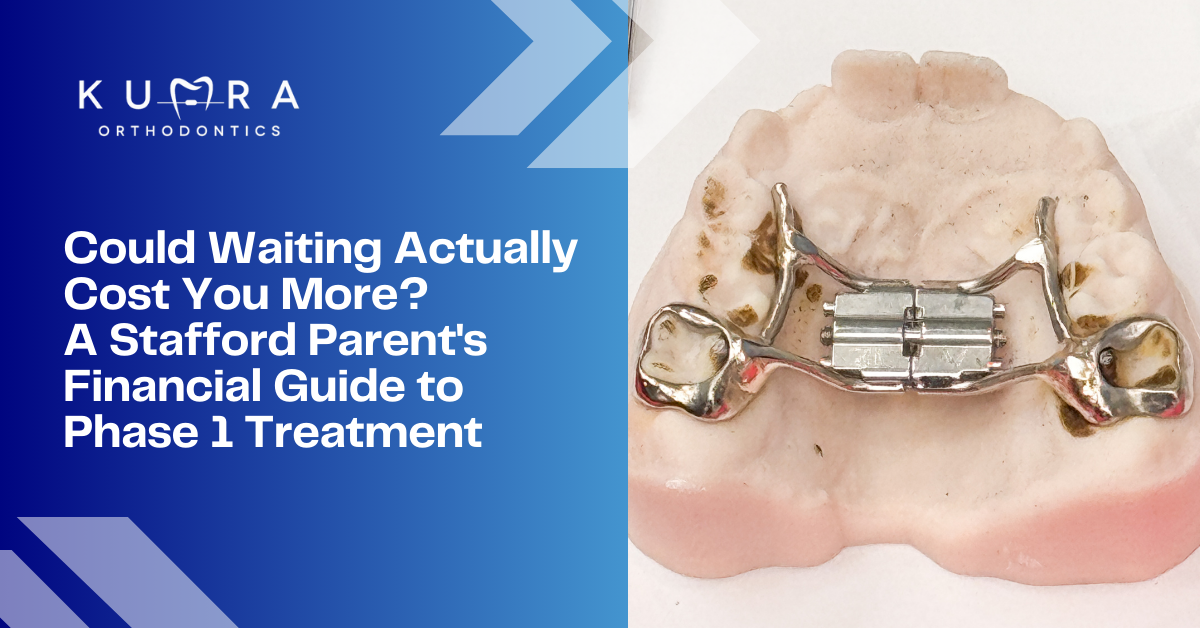
- Health ROI: The benefits extend beyond straight teeth. Widening a narrow upper jaw with a palatal expander increases the nasal cavity volume. This improves airflow and reduces issues related to pediatric sleep apnea. Correcting a poor bite also prevents irreversible tooth wear, which leads to a lifetime of crowns ($1,000–$2,500 per tooth) and root canals ($900–$1,600 per tooth).
- Emotional ROI: For a child from age 7 to 10, visible dental issues are a source of self-consciousness. Studies show dental features are one of the top reasons for teasing among peers. Correcting these issues before middle school helps prevent the “smile inhibition reflex,” where a child learns to hide their smile. It builds a foundation of confidence that supports social development.
The Hidden Costs of Waiting: Why “Watchful Waiting” Can Be More Expensive
Waiting is not a “free” option. For children with the urgent conditions listed above, waiting allows minor issues to become major problems. These problems are more difficult and expensive to fix after jaw growth is complete.
For example, an untreated crossbite in a 7-year-old leads to permanent facial asymmetry. By age 15, correcting this requires a much longer and more complex course of braces, and in some cases, surgery. What was a simple 9-12 month intervention becomes a multi-year, multi-thousand-dollar problem.
Demystifying the Cost: What Are You Paying For?
The cost of Phase 1 treatment is not arbitrary. The cost is based on the specific tools and time required to achieve the foundational goals for your child. Key factors include:
- Complexity of the Case: Correcting a single crossbite is different from managing severe crowding and a harmful habit simultaneously.
- Type of Appliance Needed: The treatment involves a specific appliance, like a Palatal Expander to widen the upper jaw, a Space Maintainer to hold room for a permanent tooth, or Limited Braces (often on the front four and back two teeth) to correct alignment or protrusion.
- Treatment Time: Interceptive treatment is efficient, typically lasting between 9 and 18 months.
Making Early Orthodontics Affordable for Your Family
At Kumra Orthodontics, we are committed to making this investment manageable for your family. Our treatment coordinator is an expert at helping families navigate their options. “My job is to help families make the finances work,” she often says. “We have many tools at our disposal, and we’ll find a plan that fits your budget.”
Leveraging Your Insurance, FSA, and HSA in DC & VA
Do not let financial questions be a barrier. Financing orthodontic treatment is possible for this qualified medical expense.
- Dental Insurance: Most plans with orthodontic benefits cover a portion of Phase 1 treatment, typically 50% up to a lifetime maximum. Our team are experts at verifying your benefits and handling claims to ensure you get the most from your coverage.
- FSA & HSA Funds: Use pre-tax dollars from your Flexible Spending Account (FSA) or Health Savings Account (HSA) to pay for Phase 1 treatment. This provides an immediate discount equivalent to your tax rate.
Flexible, 0% Interest Payment Plans at Kumra Ortho
We believe cost should not stand in the way of a child’s health. We are proud to offer customized, in-house payment plans with 0% interest. After an initial down payment, we will work with you to structure a monthly payment that fits into your budget. The payment is often comparable to a family’s cell phone bill.
Your No-Risk Next Step: Get a Personalized Assessment
This guide provides a framework for understanding Phase 1 orthodontics, its necessity, and the investment required. The only remaining question is: what is the right path for your child?
The answer to that question starts with a simple, no-pressure conversation. We invite you to schedule a complimentary consultation at one of our welcoming offices. Dr. Kumra or Dr. Abdolahi provides a thorough evaluation and gives you a definitive, honest recommendation. This is the first step to ensure a lifetime of health and confidence for your child.
Washington, DC Office: (202) 785-8672
Stafford, VA Office: (540) 602-7251
